
Shortwave Diathermy (swd) — How It Works & What It Treats
Also known as SWD. What Shortwave Diathermy (swd) is, how it works and what it treats — explained by CB Physiotherapy's clinical team.
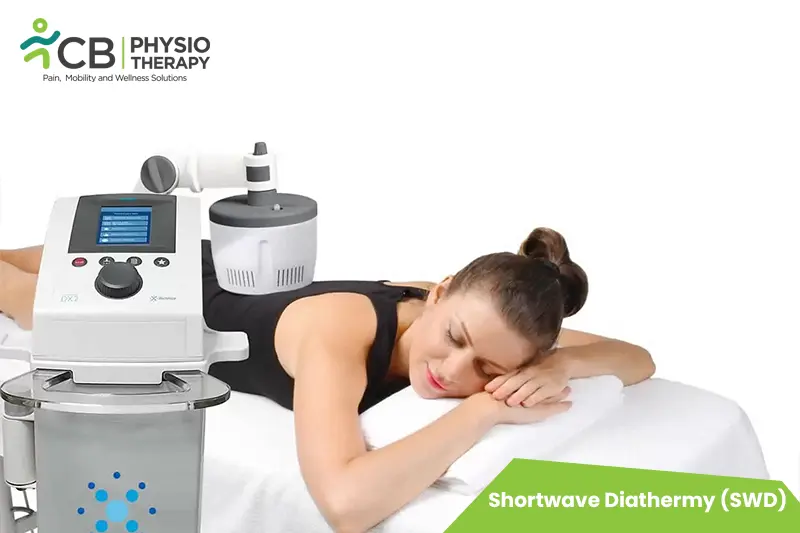
How Shortwave Diathermy (swd) works
Shortwave Diathermy (swd) (also called SWD) earns its place in a recovery plan when the assessment says it fits — that is the honest answer to "does it work?", because the same treatment helps one diagnosis and does little for another.
Used on the right case, at the right dose, alongside exercise and hands-on care, Shortwave Diathermy (swd) supports pain relief and recovery without medicines. Your physiotherapist will tell you plainly whether your case is one it helps.
Shortwave Diathermy (swd) — techniques & equipment
What the treatment actually involves — your plan combines the pieces your assessment calls for.
Assessment before application
Your physiotherapist first confirms Shortwave Diathermy (swd) suits your diagnosis — and screens for anything that rules it out.
Targeted application
The treatment is applied to the specific structures your assessment identified, at a dose set for your case.
Paired with active rehab
Exercise and movement retraining run alongside, so the gains each session makes are kept.
Reviewed and progressed
Your response is checked every session; the plan is adjusted rather than repeated on autopilot.
Conditions Shortwave Diathermy (swd) treats
Where it fits best — your assessment confirms whether it belongs in your plan.
- ✓ Cervical Spondylosis →
- ✓ Frozen Shoulder →
- ✓ Arthritis →
- ✓ Knee Bursitis →
- ✓ Ankle Sprain →
- ✓ Tennis Elbow →
- ✓ Pain or stiffness that has not settled with rest
- ✓ As part of a wider, assessment-led recovery plan
- ✓ When your assessment identifies the specific problem Shortwave Diathermy (swd) addresses
What a Shortwave Diathermy (swd) session looks like
Step by step — from screening to treatment to what comes next.
Screening and consent
A quick reassessment and safety screen — you will know what the session involves and why before it starts.
The treatment itself
Shortwave Diathermy (swd) applied to the targeted area — most patients find sessions comfortable, and you can speak up at any point.
Active follow-through
Exercise or movement work right after, while the treatment effect is fresh.
Response check
What changed and for how long — the answer shapes your next session and the plan.
Benefits of Shortwave Diathermy (swd)
- ✓ Dosed to your case after a proper assessment
- ✓ Always combined with active rehab, for results that last
- ✓ Available at CB clinics near you — and at home where equipment allows
- ✓ Drug-free support for pain relief and recovery
- ✓ Delivered by certified physiotherapists, never unsupervised
Safety & contraindications
How CB Physiotherapy delivers Shortwave Diathermy (swd)
You will not walk into CB Physiotherapy and simply receive Shortwave Diathermy (swd) — you will receive an assessment, and Shortwave Diathermy (swd) if your case calls for it. That order matters: it is how we make sure every session moves you towards a goal rather than just filling a slot.
Your plan runs on Fizo IQ™ — diagnosis, root cause, milestones, goals — and Shortwave Diathermy (swd) is combined with hands-on care and exercise as indicated, at a clinic near you or at home where the equipment allows.
Real published prices from our physiotherapists for Shortwave Diathermy (swd) in India — your exact quote is confirmed after assessment, before you commit. Packages save 10%.
Get Shortwave Diathermy (swd) near you
Certified physiotherapists at a clinic near you or at home — same-day slots, assessment-led care.
Request received!
We'll call you within 10 minutes to confirm your home visit.We'll call you within 10 minutes to confirm your slot.
Chat with us on WhatsAppShortwave Diathermy (swd), answered
Frequency: Shortwave diathermy uses a frequency ranging from 3 to 30MHz Usually a frequency of 27.12 MHz and a wavelength of 11 meters is used. Currents of such high frequencies do not stimulate sensory or motor nerves nor do they produce any muscle contraction. Shortwave diathermy can either be
1: Continuous shortwave diathermy (CSWD).
2: Pulsed shortwave diathermy (PSWD).
Continuous short-wave diathermy: Has a thermal effect more than pulsed, so it is generally used for its thermal effects whereas Pulsed short-wave diathermy has athermal effects. Shortwave diathermy uses high-frequency electromagnetic energy to generate heat, in pulsed or continuous energy waves.
Electrodes: The current is applied to the patient by a heavy, flexible, insulated cable which is used as the electrode and is coiled about or around the patient’s part to be treated.
There are two methods of application of electrode pads,
1: Contra planar.
2: Coplanar.
1. Contra planar electrode placement: The two electrodes are placed in two different planes, therefore it is called contra planar. the two pads sandwich the treating body part between them.
2. Coplanar electrode placement: In contra planar arrangement, the pads are placed side by side on the same plane. This is used to treat large body parts such as the upper back. lower back. The electrodes should not be placed too close as the wave path does not go deeper.
Continuous vs. Pulsed Mode:
1. Continuous mode: Generally used for deep tissue heating, promoting blood flow, and managing chronic conditions.
2. Pulsed mode: Often preferred for acute injuries or conditions where intermittent thermal effects are desired. It can help control inflammation and reduce pain.
Frequency:
27.12 MHz is common for SWD: It allows for deeper tissue penetration. However, lower frequencies may be chosen for certain cases.
Higher frequencies: Penetrate tissues more effectively but may cause more surface heating.
Lower frequencies: Penetrate less but also generate heat on the surface.
Intensity:
Start low and gradually increase: Initiate with a lower intensity to assess the patient's tolerance and adjust based on their response.
Consider patient feedback: Monitor for signs of discomfort or excessive heating and adjust intensity accordingly.
Treatment Duration:
The session duration varies but is typically around 15 to 30 minutes. The therapist will closely monitor the patient during the session.
Patients may experience a mild warming sensation or tingling during the session. The degree of heating depends on the intensity and mode chosen. Patients are encouraged to communicate any discomfort or unusual sensations to the therapist during the session.
Heat increases the diameter of the blood vessels, thus increasing blood circulation and removing waste products. Also increases the nutrient supply in the affected area and gives relief from pain and also reduces muscle spasms, helps to relax tight muscles, and improves the range of motion.
1: Reduces pain and inflammation,
2: Improves range of motion,
3: Promote healing in the affected area.
4: Reduces muscle spasm and stiffness.
Ultrasound Therapy:
Uses sound waves to generate heat and promote healing. It's often employed for soft tissue injuries and musculoskeletal conditions.
Thermotherapy:
Hot packs can be applied to the affected area to manage pain and promote circulation.
Infrared Therapy:
Utilizes infrared light to penetrate tissues, providing heat and promoting healing. It can be used for various musculoskeletal conditions.
Laser Therapy:
It involves the use of focused laser light to stimulate cellular activity and promote tissue healing. It's often used for soft tissue injuries.
1: Sprain and Strain.
2: Frozen shoulder.
3: Degenerative joint disease (OA).
4: Joint stiffness.
5: Tenosynovitis.
6: Arthritis.
7: Tendinitis.
8: Bursitis.
9: Myofascial pain.
10: Lumbar pain.
11: Tennis elbow, etc.
1: Certain skin conditions,
2: Pregnancy,
3: Patients who are taking blood-thinning medications,
4: Cancer,
5: Severe/excessive edema,
6: Metallic implant,
7: Cardiac pacemaker,
8: Over wet dressing,
9: Acute inflammation,
10: Infected open wound,
11: Impaired thermal sensation,
12: Recent radiotherapy,
13: Pregnancy,
14: Severe cardiac abnormality,
15: Anesthetic area,
16: Tuberculosis,
17: Reproductive organ.
1: Ensure the earthing of the machine.
2: The machine and the electrodes should be properly connected.
3: Patients should not be allowed to touch the unit.
4: Check contraindications.
5: The patient should be properly positioned.
6: Do not place it over the wet area.
7: Check the thermal sensitivity.
8: Remove metal if wearing.
9: Skin surfaces should be separated by a towel.
10: Wait for 2-3 minutes after setting.
Ready to start your recovery?
Get assessed today — find the cause, get a plan, and know when you'll feel better.