Wax Therapy — How It Works & What It Treats
Also known as Wax Therapy. What Wax Therapy is, how it works and what it treats — explained by CB Physiotherapy's clinical team.
How Wax Therapy works
Wax Therapy is one of the treatment approaches our physiotherapists draw on — always as part of an assessment-led plan, never as a standalone fix.
What makes any therapy work is the decision-making around it: whether it fits your diagnosis, at what dose, and combined with what. At CB Physiotherapy, Wax Therapy is prescribed after a movement assessment and paired with active rehabilitation, because passive treatment alone rarely produces lasting change.
Wax Therapy — techniques & equipment
What the treatment actually involves — your plan combines the pieces your assessment calls for.
Assessment before application
Your physiotherapist first confirms Wax Therapy suits your diagnosis — and screens for anything that rules it out.
Targeted application
The treatment is applied to the specific structures your assessment identified, at a dose set for your case.
Paired with active rehab
Exercise and movement retraining run alongside, so the gains each session makes are kept.
Reviewed and progressed
Your response is checked every session; the plan is adjusted rather than repeated on autopilot.
Conditions Wax Therapy treats
Where it fits best — your assessment confirms whether it belongs in your plan.
- ✓ Carpal Tunnel Syndrome (cts) →
- ✓ Arthritis →
- ✓ Baastrup Syndrome →
- ✓ Osteoarthritis →
- ✓ Rheumatoid Arthritis →
- ✓ Fibromyalgia Syndrome →
- ✓ Pain or stiffness that has not settled with rest
- ✓ As part of a wider, assessment-led recovery plan
- ✓ When your assessment identifies the specific problem Wax Therapy addresses
What a Wax Therapy session looks like
Step by step — from screening to treatment to what comes next.
Screening and consent
A quick reassessment and safety screen — you will know what the session involves and why before it starts.
The treatment itself
Wax Therapy applied to the targeted area — most patients find sessions comfortable, and you can speak up at any point.
Active follow-through
Exercise or movement work right after, while the treatment effect is fresh.
Response check
What changed and for how long — the answer shapes your next session and the plan.
Benefits of Wax Therapy
- ✓ Available at CB clinics near you — and at home where equipment allows
- ✓ Drug-free support for pain relief and recovery
- ✓ Delivered by certified physiotherapists, never unsupervised
- ✓ Dosed to your case after a proper assessment
- ✓ Always combined with active rehab, for results that last
Safety & contraindications
How CB Physiotherapy delivers Wax Therapy
You will not walk into CB Physiotherapy and simply receive Wax Therapy — you will receive an assessment, and Wax Therapy if your case calls for it. That order matters: it is how we make sure every session moves you towards a goal rather than just filling a slot.
Your plan runs on Fizo IQ™ — diagnosis, root cause, milestones, goals — and Wax Therapy is combined with hands-on care and exercise as indicated, at a clinic near you or at home where the equipment allows.
Real published prices from our physiotherapists for Wax Therapy in India — your exact quote is confirmed after assessment, before you commit. Packages save 10%.
Get Wax Therapy near you
Certified physiotherapists at a clinic near you or at home — same-day slots, assessment-led care.
Request received!
We'll call you within 10 minutes to confirm your home visit.We'll call you within 10 minutes to confirm your slot.
Chat with us on WhatsAppWax Therapy, answered
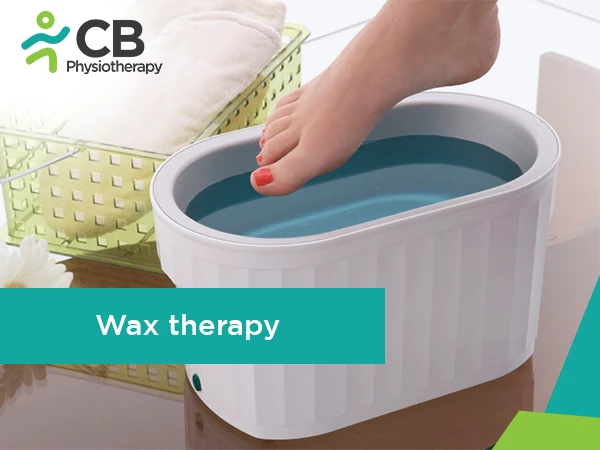
Wax therapy is a form of deep heat therapy one of the most effective ways of applying heat to improve mobility by warming the connective tissues. Wax Therapy, involves the application of molten paraffin wax, to the connecting tissues causing muscle relaxation and improving joint mobility. It is mainly used to treat Painful hands and feet. It is used in combination with common mobilizing techniques and customized exercise programs to achieve better results.
1: Relieving pain
2: Decreases joint stiffness
3: Helps in increasing the blood flow
4: Decrease joint stiffness
5: Decreases muscle spasms
6: Decreases inflammation.
You need a paraffin wax bath, a pair of mittens, and about 1 kg (2lb) of paraffin wax. If you look after the paraffin wax, you may reuse it and it may last almost 2 years or more. You will need a paraffin wax bath that has a thermostat so that you can be able to control the heat and avoid overheating. We strongly recommend you test a small area on the inside of your wrist before a full immersion of your hands or feet. In Wax Therapy, Molten Paraffin wax is applied to the skin in the form of layers so that it gets built up. Then the wax starts getting hard upon coming in contact with air away from the wax bath. The wax is then peeled off with no pain and the area is now ready for Massage, Exercise, Stretching, or any additional therapeutic measures.
2: Once melted at the right temperature according to the thermostat, allow the wax to cool a little.
3: Wash your hands or feet thoroughly before using the wax.
4: Test a small area on the inside of your wrist to make sure the temperature is suitable for you before you fully immerse your hands or feet.
5: Dip your hands or feet into the wax and then completely remove them. Allow the wax to begin solidifying. Rapidly re-dip for another few seconds and remove again. Separate the fingers or toes before dipping to allow the wax to coat all around them.
6: Repeat the process until you have built up to four or five layers. Then rapidly wrap the hand with one of the following: a. Plastic liner b. Foil c. Greaseproof paper d. Roasting bag. When they are in place put your hand or foot inside the mitten or you can use an old towel and wrap it around your hand or foot.
7: Leave the mitten or the towel for approximately 20-30 minutes.
8: Peel off the wax and make it into a ball, exercising the fingers by gripping and ungripping the wax before returning it to the pan for future use.
9: Moisturize your hands/feet using emollients or moisturizers.
10: Continue to exercise the joints for at least ten minutes after the procedure.
11: Make sure the wax temperature is not more than 51-degree centigrade when you start your treatment
1: Osteoarthritis
2: Rheumatoid Arthritis
3: Fibromyalgia
4: Joint Mobility issues
5: Scleroderma
6: Raynaud's or any rheumatic pains
Paraffin wax is tested in a lab to make sure it’s safe and hygienic to use on the body. It’s completely natural and has a low melting point, which means it can be easily applied to the skin at a temperature low enough not to cause burns or blisters. However, if you have very sensitive skin, paraffin wax may cause heat rash. Heat rash results in small red bumps on the skin that can be itchy and uncomfortable.
1: Burns: Care must be taken to ensure the wax is not too hot when applied to the skin to avoid burns.
2: Allergic reactions: Some individuals may have allergic reactions to the ingredients in the wax or additives used in scented varieties.
3: Skin irritation: In rare cases, wax therapy can cause skin irritation or exacerbate existing skin conditions.
2: Diabetes
3: Skin rashes
4: Wounds
5: Cuts
6: Open Sores
7: Inflammatory Skin Conditions
Ready to start your recovery?
Get assessed today — find the cause, get a plan, and know when you'll feel better.